

Anthropomorphism 2: Revenge of the Dangling Modifier
by Jean Winkler, Manuscript Editor III, RadioGraphics
In a previous Radiology: Behind the Scenes post, I discussed the ways that anthropomorphism can take credit for the radiologist’s work. This month, I want to share another common type of anthropomorphism that can creep into a manuscript without your knowledge: dangling modifiers. Modifiers have a tendency to dangle when they have nothing to modify (ie, no subject), leading to the wrong noun being misinterpreted as the subject, sometimes with amusing results. Consider the following sentence:
After performing MR spectroscopy, the nude mice were fed and returned to their cages. (Note: No mice will be sacrificed in my examples.)
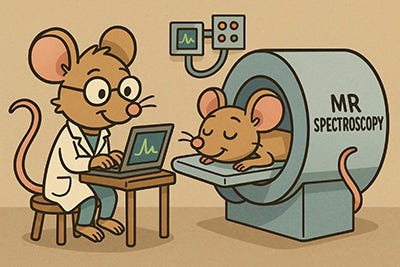
When a sentence with no stated subject begins with an introductory phrase (especially one with an “ing” verb), the noun directly after the comma is generally assumed to be the subject. So this sentence suggests that the mice performed the imaging, which is quite a feat for even above-average rodents. The subject of a sentence is often ambiguous when writers choose to avoid “I” or “we,” or when they prefer not to identify the person performing each action.
Manuscript editors are trained to identify dangling modifiers and to ensure that the correct noun, whether stated or implied, is performing the action in all sentences. This dangler can be fixed either by adding a subject (eg, we, the authors, or someone else) or by rewriting the introductory phrase a bit:
After MR spectroscopy was performed, the nude mice were fed and tucked into their tiny beds for a nap.
Although the subject is still not explicitly stated, the edit removes the ambiguity and the unintended humor about mice and their radiologic skills.